Showing posts with label Section 106. Show all posts

Saturday, December 14, 2013

Camp Low Echo's Next Chapter


In the waning days of WWII, the Rogue Valley Girl Scouts Council decided that renting time at the Boy Scouts campground in southern Oregon wasn’t going to be a permanent solution.  In 1946 they negotiated a lease with what is now the Fremont-Winema National Forest for acreage at the southeastern tip of Lake of the Woods, in Klamath County, and set about planning to build what would become Camp Low Echo.  John Boyle, the famed hydroelectric engineer of the California Oregon Power Company (and father of two girls) laid out the campground and designed the main lodge.  The following year two groups of fathers set to work, one group set about dissembling a few buildings at Camp White, a US Army Cantonment, and the other using those salvaged materials (even the windows) to build a 40x100’ foot building facing the lake.  They got some other neat stuff from Camp White too, but more about that later.  The main lodge was later dedicated as “Beaver Lodge,” after the camp name of a scout leader.


For the next seven decades 1000s of girls spent their summers at Camp Low Echo, learning crafts, swimming in the lake, canoeing and spending time in the woods among friends.  It was a popular spot.  The Girl Scouts (aided by Kiwanis and Lions) built more buildings, cabins, fire-rings, and sleeping platforms, that allowed multiple groups to use the camp’s 30 acres.  None of these buildings, not even Beaver Lodge, were architectural wonders and most were built of donated materials, but they did what was needed, and for the summers, kept the bugs out and provided shelter.  When the snow fell, the uninsulated buildings were vacant, but their green metal roofs kept them dry until the next summer.
 

Scouting, for both boys and girls, is somewhat on the wane, as these traditional activities compete with sports, video games, and other things.  A few years ago the southern Oregon Girl Scouts Council, along with several other councils, were merged into a single statewide council based in Portland.  One of the first things that new body decided was that they had too much property.  Sadly, one of the facilities to be jettisoned was Camp Low Echo, ending any formal association between the scouts and the camp  In September of this year, after a deliberate process, the Forest Service lease for Camp Low Echo was transferred to a non-profit organization, which also purchased the Girl Scouts’ buildings with an eye toward a mixture of restoration, removal and new construction that will continue Camp Low Echo’s essential focus, while making improvements to allow the facility to operate year-round.

One thing that I expect to remain will be the luggage carts… a series of wooden boxes (now painted red) with 48” diameter steel rimmed wheels.  The scouts used them to lug sleeping bags and duffle bags from the parking area to the far reaches of the grounds (where cars can’t go).  What may not have been remembered is that these carts are also surplus from Camp White, where they began life as the garbage wagons.  I am thinking that Beaver and the other early leaders did some heavy cleaning before they were re-purposed!


The exact nature of the upcoming changes hasn’t been decided yet and for the moment exploration is on-going to evaluate the existing buildings and see how, and if, they can be upgraded to serve a year-round purpose.  Many were built of salvaged materials, often by well-meaning if not entirely skilled volunteer labor.  There are settlement and rot issues, and the accumulated impact of six decades of exposure with minimal maintenance.  And, of course, the expectations of Girl Scouts in July isn't the same as what you or I might expect in January.  What is clear is that Camp Low Echo has a distinctive style and a character that is formed by its buildings, but that character is also just as dependent on the layout and setting.  The use of materials and even the colors of the structures just scream “Camp.”  Whatever happens, I am pretty confident Camp Low Echo in 2014 is going to be easily recognizable as an evolution in what the Girls Scouts started six decades ago.  At least that’s the plan.

Tuesday, July 23, 2013

Alex Schomburg, PGE's North Fork-An Update


A while ago I reported on a mural painted by noted comic and science fiction magazine illustrator Alex Schomburg that was installed in Portland General Electric’s North Fork Fish Viewing Station in 1963. Schomburg  Since then much on that project has happened.


 Schomburg, as we already knew, was a key figure in the so-called Golden Age of Comics, and was responsible for 100s of covers for some of the most iconic magazines ever published in that genre.  The PGE mural led us, eventually, to Mr. Schomburg’s estate (Estate), maintained by Alex’s grand-daughter, Susan.  Susan has been a wonderful source of information on Schomburg and, as things developed, provided us with information we’d never have obtained otherwise.


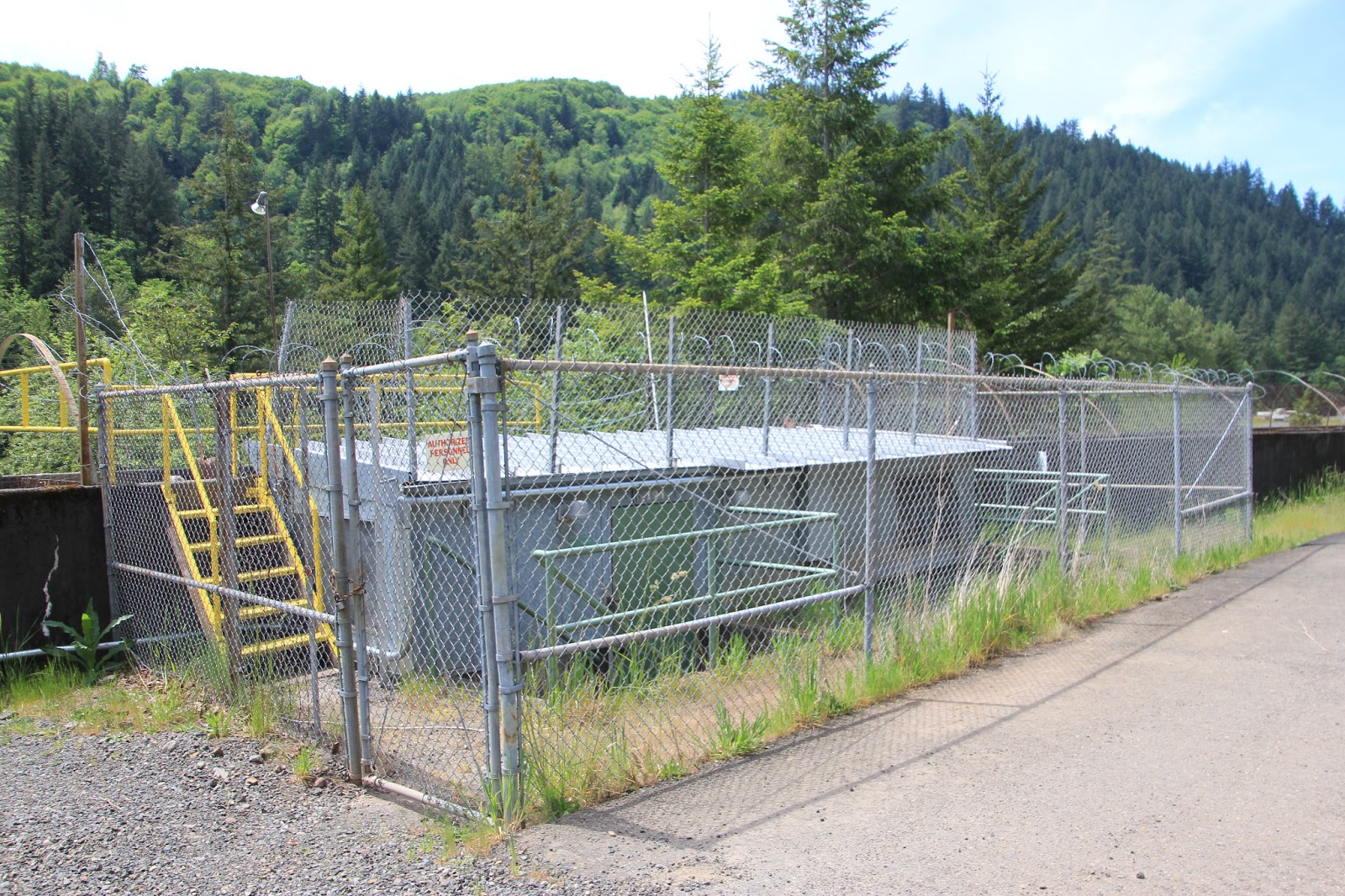
PGE, as part of its improvement of the fish passage at the North Fork Dam was required under Federal law to mitigate some of its effects on historic properties.  The Fish Viewing Station, closed to the public since 9/11, was sitting rather forlorn well within a secure area and nobody really remembered the mural was even there.  So, in consultation with Oregon SHPO, we decided to restore the mural, relocate it to a more accessible location, and tell the public the story of not only the North Fork fish ladder (once the longest in the world) but of the amazing artist that PGE found to help educate 1000s of school children who visited the project between 1963 and 1991.

Nina Olsson, a fine arts conservator in Portland, took on the project of restoring the 4x8 main panel and the two 40” x 48” side panels.   After 40 years sitting 10’ from what amounts to a river, in an unheated (okay, space-heated occasionally) metal building, they were dirty, the photos were stuck to the glass, and the colors were, um, a bit muted.  Not anymore!


We developed two interpretative panels to flank the historic ones; one on the history of the North Fork Fish Ladder and the other on Schomburg.  At this point it looks like the entire assembly of five framed panels will go on a long-term loan to a local museum.  There will be a grand “unveiling” at some point this Fall and the public will be invited.  Stay tuned!


Monday, June 3, 2013

Covered Bridges-Managing Change/Carrying Traffic


Although the field and much of its infrastructure is called “preservation” the reality is that a large percentage of what is reviewed by the State Historic PRESERVATION Office, or NPS’s Technical PRESERVATION Services division, is better described as “rehabilitation.”  Rehab, in this world, involves transforming a building or structure to a new use or updating a continuing use in a manner that is respectful of history.

Determining where the line is between respect and remuddling is often subjective and it can even be a source of disagreement among “preservation” professionals.  I recall a project from years ago in which a pioneer era structure was to be rebuilt (from the ground up, it had been entirely lost) and there was considerable and heated debate about whether the sills and floor beams had to be hand-hewn timbers or if they could be the less-expensive and likely more durable, pressure-treated lumber.  On the one hand nobody was ever going to see the beams, beneath the floor boards, and on the other the original did have hand-hewn timbers.  I thought the former was nice but unnecessary and pushed for pressure-treated.  Others thought the presence of PT amounted to sacrilege.

“Preservation” v. “Rehabilitation” has reared its head in on-going discussions surrounding covered bridges.  The small number of covered bridges that survive in Oregon (about 50 out of more than 400 we once had) are beloved in their communities (and Oregon, despite the losses, still has more covered bridges than any state west of the Mississippi).  The issue, simply put, stems from the undeniable fact that there are good reasons why Oregon’s public works and state transportation officials have replaced covered bridges over the years.  Wood over water, in western Oregon, isn’t a great match.  Wood rots, and it needs to be replaced.  Concrete may not have as much character, but in times of diminishing budgets, it’s a heck of a lot easier to maintain.

To compensate for that fact, there are special sources of money to keep covered bridges standing, and that makes sense not just to keep them as functional elements of the transportation system and our history, but from an economic development and tourism standpoint.  For example, I was at a covered bridge a few weeks ago, the McKee Bridge, way out in the Applegate Valley.  They have a register for visitors to sign.  There were people from all over North America that had driven 30-40 miles off the Interstate to see that bridge.  That’s a good thing, and justifies the expense of retaining these iconic structures.  It's rare to visit a covered bridge that somebody doesn't stop by to take a photo, check it out, or lay out a picnic or something.  Oregonians, Americans, love covered bridges.

But keeping them standing requires regular maintenance. And, at the same time that public money is drying up, the quality of timbers is declining from the old growth that bridge-builders used in the early 20th century.  That means that even if you can get the large timber members needed to build certain elements in a covered bridge, they don’t have the same carrying capacity of the old growth, because the wood isn’t as good.  And then, of course, modern vehicles, especially trucks, are much much larger than they were in 1930 or 1940, so if a bridge is to carry legal loads as part of the transportation system, the new timbers ought be carrying MORE weight than the original design. 


All of this has led bridge designers and public works officials to look for new ways to upgrade, to rehab, Oregon’s covered bridges while meeting the requirements of the traffic system AND honoring history.  That’s a fine balance.  One method, an easy method, would be to replace the floor system of a covered bridge with steel or even concrete, transforming the truss into what would amount to a decorative feature.  Nobody wants to do that (though there are many many covered bridges with concrete approach spans in Oregon…. There was a time when the approaches weren’t considered historic at all).  Another method is to replace the original timber elements with new timbers, up-sized to increase capacity, but that too changes the character of the bridge, even where such material is available (YOU try to find a 20” x 18” timber beam 60’ feet long!).  In some cases original timbers can be strengthened by post-tensioning, the installation of small steel cables or rods that tighten the truss and increase its carrying capacity.  

But the most typical method, at least of late, is to replace damaged members (typically floorbeams and stringers that are below the roadway) with glu-lams, laminated wood that is matched in dimension to the original feature.  Glu-lams are just little pieces of wood, usually 2x, stacked, or glued (laminated) to create a single, larger, member.  Because of the stacked lamination and the multiple grain patterns, glu-lams actually carry more load than a single, solid, timber of the same size.  Of course replacing original, solid, timber elements with glu-lams is a change to the original design, justified to keep the bridge standing perhaps, but still a change.  There are differing opinions, from a technical standpoint, about whether that change is appropriate or not.  I don’t think most people even notice, but maybe that’s just wishful thinking.

Thursday, May 23, 2013

Camp White – Mission Appropriate


I have written before about the Camp White Station Hospital, in White City, Oregon.  It’s a sprawling 145-acre site that has 50+ buildings constructed in 1942 as part of the US Army’s training mission in the early days of World War II.  Since 1948 the Station Hospital, built of “permanent” construction, has been owned and operated by the Department of Veterans Affairs, providing service to former members of the military.

 
Way back in 1948 the VA was opposed to taking over the Station Hospital for a variety of reasons but politics (in the form of Wayne Morse) won the day, and they have operated the facility ever since.  In recent years, as the “permanent” buildings of Camp White became older and ever-less consistent with the VA’s mission of quality service, the rub between history and function has grown.  To its credit, the VA has maintained, and modified, and upgraded the buildings as it is able, transforming some of these WWII behemoths (the buildings are HUGE) into state-of-the-art medical service facilities.  But in the past few years, as demand for veteran’s services grows, the deficiencies of Camp White’s buildings, no matter how historic, have become a greater obstacle to the VA’s primary care mission.  In 2009 we helped to create a Manual for Built Resources Blog that identified appropriate strategies for upgrades, but some aspects of the 1942 buildings just can’t be reasonably fixed.  Chief among those is the simple fact that most are made of Structural, or Hollow Clay Tile.  This once popular building method (it was both cheap and fireproof) was something akin to terra cotta Lego, but without the little interlocking buttons.  As you can imagine mortared and stacked blocks, held together by plaster on the inside and brick veneer on the outside (at least at Camp White) doesn’t perform particularly well in a seismic event.  Fixing that problem is usually accomplished by building a structural cage inside and then encasing everything in concrete, chewing up most of the interior space.  And interior space is already at a premium at Camp White as the VA attempts to fit vets into rooms designed more than fifty years ago for short term occupancy.

The bottom line is that the VA, after considerable thought, is in the process of removing about 30 historic buildings at Camp White to make way for new construction that is safe, efficient, and meets the needs of the population that they serve.  And let’s face it, for most of that population historic preservation is pretty far down the list of priorities.   So, on the one hand, the loss of a lot of buildings is a pretty sad, if entirely understandable, turn of events.  


But there is good news too.  First, of course, is that the VA will continue to provide quality services to America’s veterans in southern Oregon.  And the VA isn’t removing all of Camp White.  Many of the 1942-era structures, including several of the key properties like the Administration Building (the top photo), will remain in use, upgraded and modernized as needed under the Manual, for a long time to come.  And the VA has taken the character of its historic site to heart in the design of the new, replacement, buildings that it will construct after demolition.  Many will follow the military designs established in 1942, right down the pitch of the green asphalt roof and the brick veneer.  Check out the two buildings below…one is historic (and scheduled for removal and replacement) and the other was built last year.  Care to guess which is which?  And, if you have ever been to the “Dom,” (okay, Southern Oregon Rehabilitation Center & Clinics) you know about the two-story hallways that connect almost the entire campus.  The hallways, whether original or rebuilt, will remain a part of the campus too.  


 I think if a solider that trained at Camp White, and had occasion to visit the Station Hospital during WWII, were to return for a visit in a few years when this is all completed, he’d feel right at home.  And the VA, for its part, will likely make sure through its continued support of the Camp White Historical Society, and maybe some interpretative signage, that others can also appreciate what’s so significant about the “The City in the Agate Desert” too.