Showing posts with label Streamlined. Show all posts

Monday, March 4, 2013

Medford’s Summit-Fairmount Survey Update


Last Fall I reported on the beginning of this project, to survey an early residential neighborhood west of downtown Medford. Tama has been out taking photos, and in, entering data into the State’s MS-Access database.  Despite some minor glitches, she’s pretty much done, having documented more than 800 buildings built prior to 1964, some 65% of which are at this point considered potentially historically significant.

 It’s a great neighborhood, filled with all sorts of  hidden gems from Medford’s earlier days.  There are vernacular farmhouses, built before this was part of the city and before the land had been divided into blocks and lots (there are about ten additions plats in the survey area, including both Summit Addition to Medford and the Fairmount Addition, hence the name). 


After 1900, after the additions were platted, people started to build bungalows, and craftsmans, and what are termed “foursquares.”  And then, from after WWI, there is the occasional revival style, including some truly fine Spanish Colonial Revival…stucco buildings with red-tile detailing and arched windows.  And there are even a few rarities…. a “Prairie” style dwelling and the very rare (for the smaller-town PNW) Streamline Moderne residence.  Housing built after WWII includes dozens of small minimal-eave tracts, other buildings that were almost certainly relocated from Camp White, and finally the proverbial Ranch House.  It's a veritable treasure trove of nearly a century of American residential architecture, documenting Medford’s founding, boom, lulls and post-war explosion all in one easily walkable, nicely treed, gridded neighborhood.

We will be finishing up the data, drafting the summary report for the city, and moving this project forward over the next 30 days.  It will be interesting to see what happens next in Summit-Fairmount.  There are LOTS of possibilities.  It’s a great neighborhood, finally getting some recognition.

Sunday, November 25, 2012

Littrell Building, Medford...Pieces of the Past


The Littrell Building, which stood at the corner of 6th and Bartlett in Medford’s downtown historic district, was designed by Frank Chamberlain Clark and built by Elmer Childers for local investor John Tomlin in 1936.  Its original tenant, a Safeway market, occupied the prominent corner volume until 1945 when E. A. Littrell purchased the building and moved his auto parts company there.  Littrell expanded to the east, doubling the space and matching the design.  The company occupied this corner for more than four decades.
 
Next, Lithia Auto purchased the Littrell Building and used it as part of their downtown service complex.  In 2006, with funding from the Medford Urban Renewal Agency (MURA), Lithia undertook a façade renovation and brought the structure back to some of its original cool design, painting the engaged columns and the nifty shield-like finials. I think they even won an award.

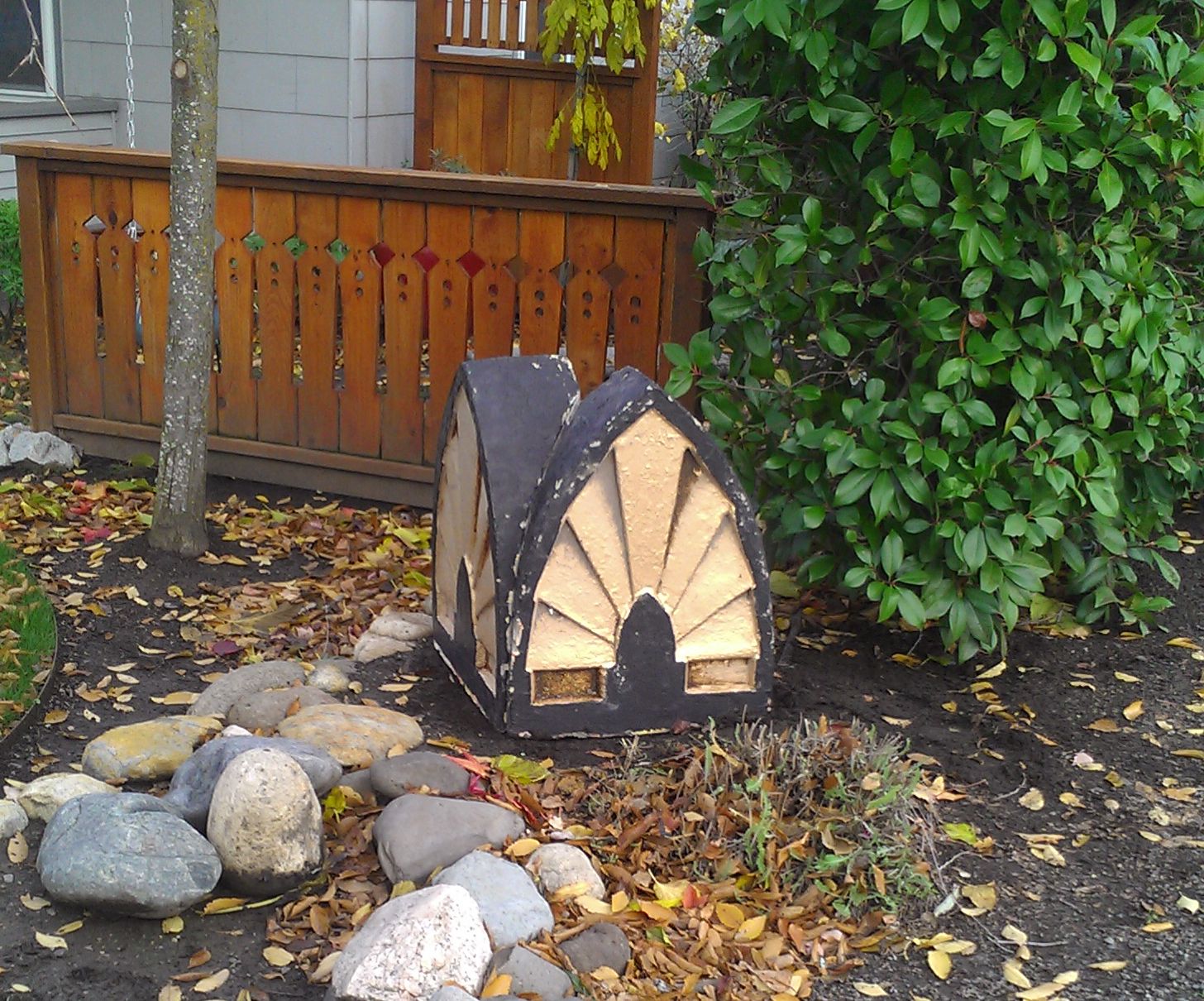
Alas, as Lithia began to design its new corporate home, and the adjacent development and park blocks that are to be known as “The Commons,” in downtown Medford, the Littrell Building was demolished.  Lithia agreed to keep the finials (and the sign block) and will use most of them as landscape elements in the new park, along with some interpretative material on this history.  They also plan to keep the “arch” from the old Greyhound Bus Depot (1949), a great Streamline Moderne building that was designed by Clark’s partner, Robert Keeney.  The future of that, unfortunately, is somewhat up in the air, but I’m hopeful that vision will out and the restored arch will remain as part of the design.  I imagine there will be more on that later.
 
Anyway, some of the finials turned out to be extras and I was pleased to be able to save two of them.  They are happily on display as yard art….not a perfect preservation solution by any means, but certainly better than the dump, and surely mitigated by the fact that the majority will be restored and retained in the new Commons park.  These little curiosities, I think, serve a vital role for those times when a building can’t be otherwise saved.  They make people ask questions…and they remind us that things, even parts of things, are worth saving and have value.  In the meantime, if you know anybody that wants a three-ton 48" x 96" or so 8" thick chuck of concrete that proudly proclaims "Littrell Bldg." let me know.

Sunday, October 16, 2011

Steamline Moderne-Architecture on the Move

Medford's SOHS History Center, built as a J.C. Penney Co. Department store
 Streamline Moderne architecture, roughly popular from the mid-1930s to the early 1950s, was an effort to integrate the design sensibility of the so-called “Machine Age” with architecture and new technologies.  Owing much of its inspiration to industrial designers like Walter Dorwin Teague and Raymond Lowey, who transformed everything from trains to toasters into works of art, Streamline Moderne is often linked with Art Deco (another indistinct term) but in reality is much different.  Whereas Deco was often flamboyantly, well, decorated, Streamline is the architecture of the wind tunnel, the machine.  The best examples of the style have rounded corners, smooth, usually stucco, surfaces, portal-type windows or large banks of glass block.  In the day, Streamline Moderne owned more to the design of cars and planes.  It was architecture of movement, that looked like it was going somewhere, a characteristic that once caused Frank Lloyd Wright to famously respond to a question of his own lack of interest in the style by stating that when “HE” built something, it stayed put.


Moderne, achieving popularity during the Depression and continuing into the postwar period, was adopted for an entire host of new building types linked to technology.  As a result, I run into them often and have always rather been fond of the style.  Many of the early Control Houses and related buildings of the Bonneville Power Administration were designed in Streamlined Moderne and those that remain are textbook examples of industrial architecture looking for new forms to house new, and “modern” technology, as shown at the Covington Untanking House.  Gas stations were also often built in the style, as in Walter Dorwin Teague's famous designs for Texaco.  The three lines at the cornice are literally called "speed lines," as shown in this fine example from La Grande, Oregon.

I’ve always had a mild desire to write a book on Streamline, which gets short shrift in most architectural histories and is in and of itself the subject of just a few studies of any quality.  Often lumped with, and always over-shadowed by Art Deco (which, let’s face it, makes for better images) or even WPA-Moderne, Streamline Moderne is often mis-understood and little appreciated or just confused with other styles. 

Last week, on my way along the Gorge toward eastern Oregon, I drove around The Dalles and stumbled across their absolutely amazing high school, completed by an architect unknown in 1941.  It’s a great great building....certainly worth more than few photos.