Showing posts with label Vernacular Architecture. Show all posts

Wednesday, August 21, 2013

Phoenix Update-Devenney-Steadman RIP


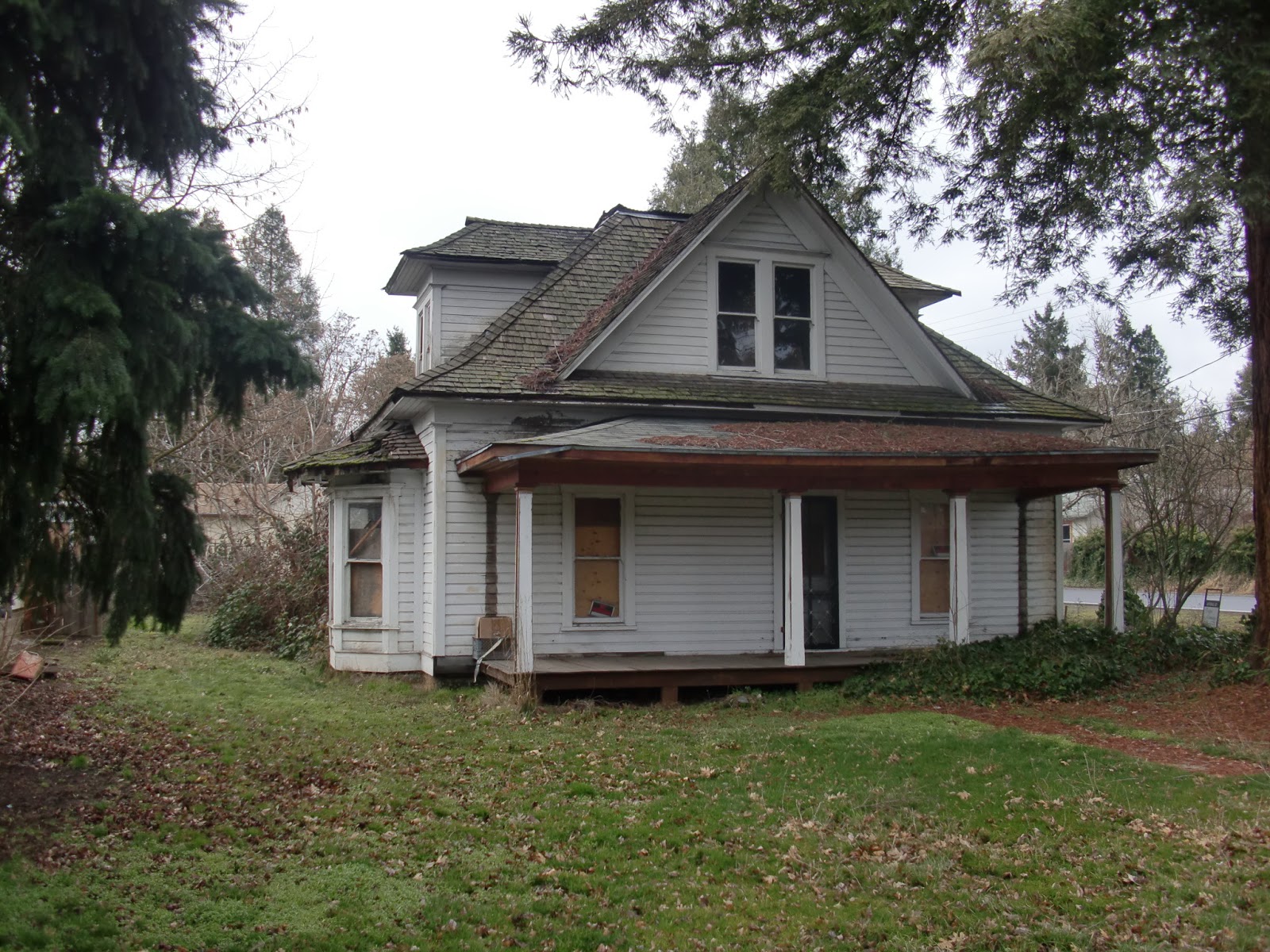
Well, you can’t say we didn’t try.  When last we left the Devenney-Steadman House, the Phoenix City Council had approved its demolition but the owners were willing to wait awhile before actually razing this fine 19th century house, in case somebody wanted to move it.  The Phoenix Urban Renewal Agency put together a plan PHURA that would have relocated the Steadman House to a prominent corner lot on Main Street, adjacent to a historic building on the north (the Phoenix Grange) and the Phoenix City Hall, on the west.  The Devenney-Steadman House would have been restored for use as PHURA’s offices, including a compatible addition to the rear for meeting room use, and the entire thing, including purchase of the land, could be paid for by the saved rental on PHURA’s offices over the remaining 15 years of life.  Phoenix got a great addition to its Main Street, saved money, created an asset for the community’s future use or sale AND undertook what would have amounted to a demonstration project that rehabilitation is not only cost effective but cool.  And Phoenix is a city that has little track record when it comes to historic preservation and re-use so who better to lead the way than local government?


On Monday of this week the issue came before the Phoenix City Council, who needed to approve PHURA’s expenditure to purchase the land.  To be clear, they didn’t need to provide any funding, they needed to approve PHURA using its own funds to purchase land and restore the Devenney-Steadman House instead of wasting it on rent.  Guess what they did?

By a vote of 3-3, with the Mayor voting to break the tie in the negative, the City of Phoenix formally thumbed its official nose at this win-win-win project.  If I were a betting man, I would not be betting on the future of restoration in Phoenix, especially the Devenney-Steadman House.  Sigh.

You can read the local newspaper report here:  Mail Tribune

Monday, March 4, 2013

Medford’s Summit-Fairmount Survey Update


Last Fall I reported on the beginning of this project, to survey an early residential neighborhood west of downtown Medford. Tama has been out taking photos, and in, entering data into the State’s MS-Access database.  Despite some minor glitches, she’s pretty much done, having documented more than 800 buildings built prior to 1964, some 65% of which are at this point considered potentially historically significant.

 It’s a great neighborhood, filled with all sorts of  hidden gems from Medford’s earlier days.  There are vernacular farmhouses, built before this was part of the city and before the land had been divided into blocks and lots (there are about ten additions plats in the survey area, including both Summit Addition to Medford and the Fairmount Addition, hence the name). 


After 1900, after the additions were platted, people started to build bungalows, and craftsmans, and what are termed “foursquares.”  And then, from after WWI, there is the occasional revival style, including some truly fine Spanish Colonial Revival…stucco buildings with red-tile detailing and arched windows.  And there are even a few rarities…. a “Prairie” style dwelling and the very rare (for the smaller-town PNW) Streamline Moderne residence.  Housing built after WWII includes dozens of small minimal-eave tracts, other buildings that were almost certainly relocated from Camp White, and finally the proverbial Ranch House.  It's a veritable treasure trove of nearly a century of American residential architecture, documenting Medford’s founding, boom, lulls and post-war explosion all in one easily walkable, nicely treed, gridded neighborhood.

We will be finishing up the data, drafting the summary report for the city, and moving this project forward over the next 30 days.  It will be interesting to see what happens next in Summit-Fairmount.  There are LOTS of possibilities.  It’s a great neighborhood, finally getting some recognition.

Friday, February 22, 2013

Phoenix Update; The Devenney-Steadman House


Since last posting on this topic, the history of what we now know as the Devenney-Steadman House has come a bit more into focus.  The house was almost certainly built about 1880 (possibly as early as 1875), by the Devenney family.  It eventually came into the possession of Callie Devenney Steadman.  “California” Devenney, born in that state in August 1864, moved to Phoenix at the age of ten and lived there, probably in this house, for the rest of her life.  At some point she married,  Mr. (Robert?) Steadman, and then was divorced (by 1900), but stayed in the family home.  Callie appears to have enjoyed a long and full life in Phoenix, surrounded by relatives and one son, Douglas.  Callie also raised several nieces and nephews from infancy, two of whom, Mrs. Milo Furry and Mrs. Elva Furry, married into another prominent Phoenix family.  Elva and Robert Furry lived on West 2nd Street, next door to Callie, in another 19th century Phoenix house that is still standing.  Callie Steadman passed away at her home, aged 79 years, in November 1943.  Her obituary described her as “A real friend to all, she will be deeply missed by her many friends and neighbors.”


As it turns out, the Devenney-Steadman House was most recently occupied, as a rental, in October 2012.  The owners, who have owned the house for many years, apparently want to move back into it in their retirement.  They felt the house wasn’t in good condition and, with some confusion, the planning department and Phoenix Historical Society originally agreed with that assessment.  However, I think that there isn’t enough information on that, and know full well that little vernacular houses like the Devenney-Steadman House, are built for “stout.”  Such houses, built of high-quality old growth timbers, are usually pretty resilient  and I’ve seen nothing in the main volume that would indicate otherwise.

Earlier this month, the Phoenix Historical Society "recanted" on their approval (their president's term, but I like it....) The Phoenix City Council issued a “stay” of the demolition permit, with the hope of finding a solution and a meeting with the owners to discuss rehabilitation options will happen within a short time.  There are several good options, I think, that would allow them to get what they want and keep this important part of southern Oregon history standing for the future.  Keep your fingers crossed!

Friday, February 1, 2013

The Future of 100-Year Old housing in Phoenix, OR


As expected, the RLS survey of Phoenix is turning up some hidden gems from the 19th and early 20th century.  Some have been lovingly maintained or restored, while others have been, um, converted or improved to meet differing demand.


But that isn't what this blog is focused on today.  It's about the doubtful future of several 100-year old Phoenix buildings that need a hero.  One, known as the Rose House, shown above, is a fine turn-of-the-century volume that is vacant, boarded up, for sale, and assumed to have a questionable, if not immediately threatened, future.  And then there is the Steadman House, as I am told it’s called.  At this point I don’t much know all that much about it, other than it surely looks to be a late-19th century vernacular farmhouse that has been ignored for a bit longer than it should have been.  My understanding is that there is a pending demolition request…whether that is from the owner, or the building official, I do not know.

 
Most people look at little old buildings like this and see nothing but work and dollar signs.  Demolition is the proverbial “clean slate” that allows people who are daunted by the challenges rehabilitation and restoration might bring a chance to convert a problem.  Or so they tend to believe.  And let's face it, it's often pretty easy to demolish a house and "start over." Permits are cheap, and demolition removes all the potential unknowns.  Anybody can build on a vacant lot.  But not everyone does and in Phoenix it is hard not to recall an owner's decision to demolish what was left of the NR-Listed Samuel & Huldah Colver House after it burned.  That lot, a big huge gap right on Main Street, has been vacant for what is now pushing a decade.
  
The other, better, way to look at a house like this is as an opportunity.  Whatever you think about 19th century vernacular farmhouses, we can all agree that they are not building any more of them.  Not all of them can be saved, of course, but most can.  Tearing the "Steadman"  house down will destroy forever one more bit of Phoenix and Oregon’s history.  Restored it could be a gem, and the good thing about these little vernacular structures is that in general they are so simple and straightforward that they are pretty easy, and inexpensive, to restore to glory.  That is if anyone wanted too. And the good news is that there are lots of qualified contractors and others willing and able to help, if they are asked.

The Phoenix City Council is apparently reviewing the demolition request in the near future.  I don't really know enough about this to have an opinion, but I hope somebody in Phoenix gives the little house a shot to survive.  It already has for quite some time and could become a gem, just like several other fine old homes brought back from death's door by creative individuals.  I'll write about Phoenix's successes in the near future too, just to be even-handed.

Wednesday, January 16, 2013

Phoenix Survey- Whatta Ya Got?


We recently began work on a survey and inventory project in Phoenix, one of the eleven incorporated cities in Jackson County.  Phoenix, originally known as “Gasburg,” was founded by the incredibly interesting Samuel Colver along Bear Creek, in the 1850s.  Colver, a former Texas Ranger, poet, horseman, and character par excellence, built a huge hewn-log home along the main road through the valley.  Colver Hall, sometimes called Fort Colver, was an imposing presence for 150 years, until it burned in a spectacular fire and was, sadly, demolished.  As a student at UofO, I was part of the effort to list the building on the National Register, working with the great Philip Dole.  I can still recall its absolutely great attic.


But there are other fine structures in Phoenix, some almost as old as the Colver House.  One is the Hiram Colver, or Patrick McManus House, shown above as photographed by the original HABS Survey in the 1930s.  Hiram was Sam’s brother or cousin, I forget which.  The house has been listed on the register but most of the others in town are just itching to be identified.  There are dozens of 19th and early 20th century vernacular forms, foursquares and bungalows, related from Phoenix’s rise from rural service center, to railroad station, to Pacific Highway wayside.  Among the cooler things is the former Dr. Malmgren House and Store, the former a rare temple front, shown below, and the latter the last bearing stone building that I know of in southern Oregon.


The town continued to grow after WWII, and I expect to find more than a few former Camp White buildings tucked in among the small ranch houses and minimal eave designs.  And then there is all the cool commercial and institutional stuff, including a fine former Texaco gas station and the Skinner Building, a rare small-town streamline moderne two-story that even has a portal window or two.

The one thing I rather expect to be in short supply is higher-style Victorian-era.  Phoenix wasn’t that kind of town, not since it was called Gasburg.