Showing posts with label Hydroelectric. Show all posts

Tuesday, July 23, 2013

Alex Schomburg, PGE's North Fork-An Update


A while ago I reported on a mural painted by noted comic and science fiction magazine illustrator Alex Schomburg that was installed in Portland General Electric’s North Fork Fish Viewing Station in 1963. Schomburg  Since then much on that project has happened.


 Schomburg, as we already knew, was a key figure in the so-called Golden Age of Comics, and was responsible for 100s of covers for some of the most iconic magazines ever published in that genre.  The PGE mural led us, eventually, to Mr. Schomburg’s estate (Estate), maintained by Alex’s grand-daughter, Susan.  Susan has been a wonderful source of information on Schomburg and, as things developed, provided us with information we’d never have obtained otherwise.


PGE, as part of its improvement of the fish passage at the North Fork Dam was required under Federal law to mitigate some of its effects on historic properties.  The Fish Viewing Station, closed to the public since 9/11, was sitting rather forlorn well within a secure area and nobody really remembered the mural was even there.  So, in consultation with Oregon SHPO, we decided to restore the mural, relocate it to a more accessible location, and tell the public the story of not only the North Fork fish ladder (once the longest in the world) but of the amazing artist that PGE found to help educate 1000s of school children who visited the project between 1963 and 1991.

Nina Olsson, a fine arts conservator in Portland, took on the project of restoring the 4x8 main panel and the two 40” x 48” side panels.   After 40 years sitting 10’ from what amounts to a river, in an unheated (okay, space-heated occasionally) metal building, they were dirty, the photos were stuck to the glass, and the colors were, um, a bit muted.  Not anymore!


We developed two interpretative panels to flank the historic ones; one on the history of the North Fork Fish Ladder and the other on Schomburg.  At this point it looks like the entire assembly of five framed panels will go on a long-term loan to a local museum.  There will be a grand “unveiling” at some point this Fall and the public will be invited.  Stay tuned!


Saturday, January 26, 2013

Eastham, Morey, Edward, Clara and Parker


Nestled into an arc of headstones at River View Cemetery is a fine marble monument that on its west face reads “Eastham” and on its east, “Morey.”  Historians of Portland, especially of Portland’s electrical utilities, may recognize those names and wonder why they are both found on one marker.  I certainly did.

Parker F. Morey was a mechanical engineer who arrived in Portland in about 1879 and, in 1884, started the United States Electric Lighting and Power Company, one of Portland’s earliest power utilities.  Edward L. Eastham was an attorney in Oregon City.  Prominent and successful, he was among the first to recognize the hydroelectric potential of Willamette Falls and began buying up water rights there with the idea of building a huge generation plant.  In 1888 Eastham, with his water rights, and Morey, with his knowledge and Portland customer base, joined forces and created the Willamette Falls Electric Company.  Eastham was named President.  The following year the new company transmit DC, Direct Current, power from their “Station A” at the Falls all the way to downtown Portland, a distance reported at either 12 or 14 miles, depending upon the source, but universally recognized as one of the first “long distance” transmission of electricity in the world.  The rest, as they say, is history.  The Willamette Falls Electric Company was wildly successful, began buying up its competition both in generation and electric trolleys.  Morey replaced Eastham as President, when the latter died in 1891, and by 1906 the company they founded emerged as the Portland Railway Light and Power Company.  Today that firm is better known as Portland General Electric, which still produces power at the Willamette Falls.


 But still, most business partners, even successful ones who may have had high respect and friendship between them, don't share a burial plot and there was no report that Eastham and Morey were otherwise related by blood or marriage.  In the normal sense, they weren’t. 

Edward Eastham, born in Oregon City in 1848, died on January 18, 1891, before he ever saw how successful his power company would become.  He left a widow, Clara, and six children, one just an infant.  Eastham, also a State Senator, was mourned as “Oregon City’s foremost citizen.

Parker Morey, born in Missouri in 1847, lived longer, though he was just 56 years old when he died.  He and his wife Maud had three children, two girls and boy, before Maud passed in 1888.  I’m not sure exactly when, but soon after Edward’s death, Clara and Parker joined their families into one, Clara inheriting three step-children and Parker six.  When Parker died, on July 7, 1904, the entire family was with him on their farm near Oregon City.


Clara Eastham Morey, died July 23, 1927, at the age of 72.  She was survived by two daughters and four sons, two stepdaughters and one stepson.  At River View Clara's modest headstone is at the center point of the Morey-Eastham monument.  It is flanked on the west by Edward.  Parker is on the east.

Tuesday, August 14, 2012

Schomburg's Painted Fish on the Clackamas


Back in the day private and public utilities made a point of providing innovative amenities as part of their projects, allowing the populations they served to appreciate the scale and creativity that went into providing them with water and electricity on a reliable basis.  Some companies took that role to heart.  Few have done a better job over the years than Portland General Electric, PGE, the pioneer power provider that serves most of Portland’s northern Willamette Valley including Portland and Salem.

PGE’s Trojan Nuclear Power Project included this really phenomenal “Visitor Information Center,” a futuristic building complete with cool staff uniforms that wouldn’t have looked out of place on the Starship Enterprise.  There was a high-tech video-tour inside the atom and even an electric powered shuttle that took visitors and school groups right into the massive powerhouse.  Ah, the days before 911, when we didn’t have to treat infrastructure as a security risk.
  
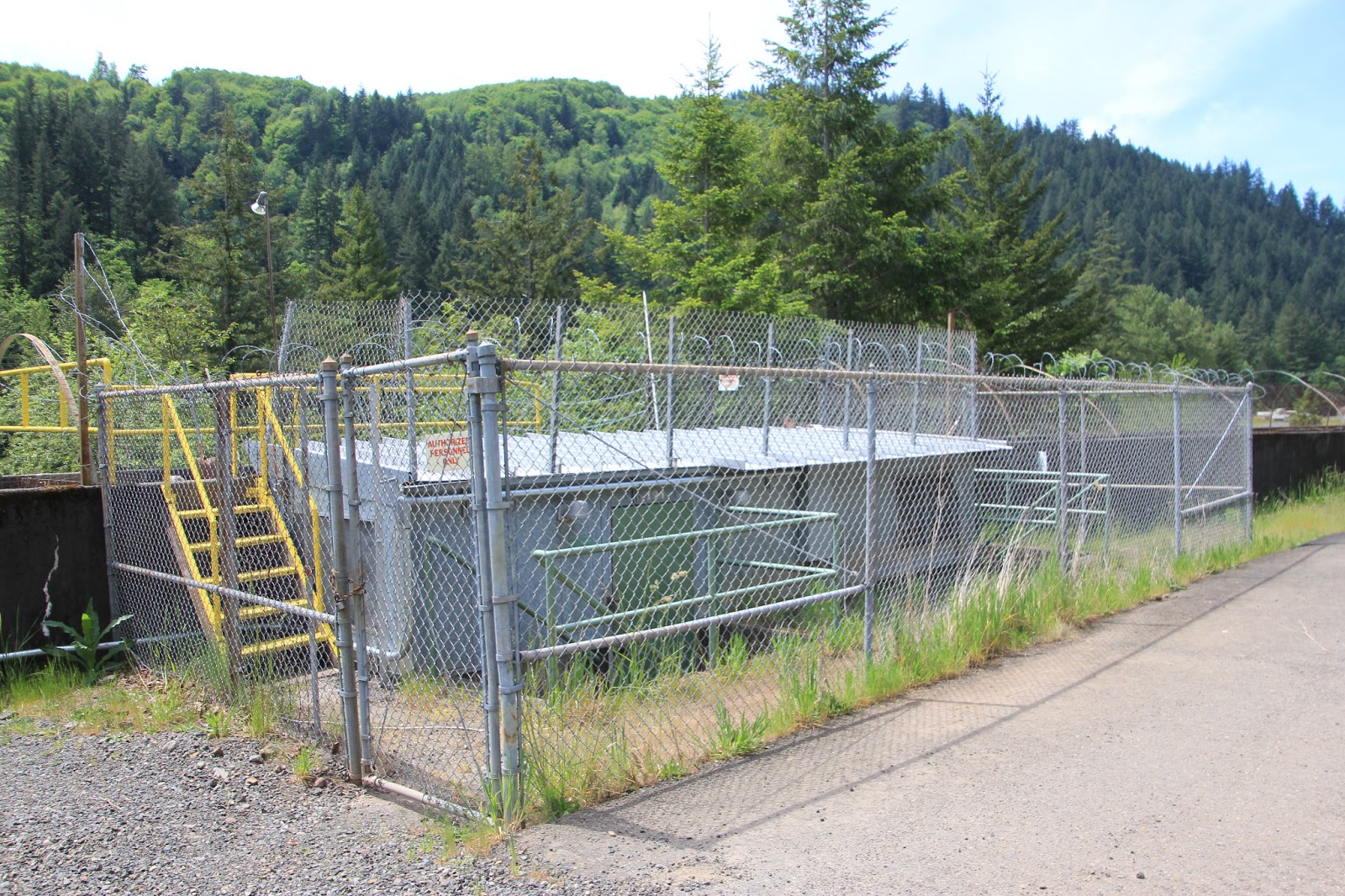
PGE's hydro side wasn't slacking off either.  On the Clackamas River, PGE developed a “Fish Viewing Station” adjacent to the North Fork Fish Ladder, at 1.9 miles long once the longest such feature in the world.  The Viewing Station, a little boxy building that looks all the world like a truck-mounted storage container, has three large windows cut into the side of the ladder, so you can see the fish swimming by.  And for the back wall, PGE hired Alex Schomburg to paint a mural, identifying the various fish species that used the ladder in incredibly realistic detail.  Installed in 1963 (as near as I can tell at this point), the viewing station and the mural were focal points for any number of school tours, as Clackamas and Multnomah county children toured the project and learned a little about how power is made, and how fish runs were protected in the process.

Now, what is interesting about this is that Alex Schomburg wasn’t just some guy off the street.  Born in Puerto Rico in 1905, Schomburg was a hugely influential artist, mostly remembered for the artwork for hundreds and hundreds of 1930-1950s comic books and science fiction magazines.  His work included everything from Captain America to concept drawings for Stanley Kubrick’s famed 2001: A Space Odyssey.  “A portfolio of Alex Schomburg’s work is a visual diary of 20th century illustration art and popular culture,” wrote Amy Wagner, in The Fantastic Art of Alex Schomburg, an article published in Illustration magazine.  You can read more about Schomburg, and see more of his fantastic art, at http://www.alexschomburg.com/ a site that is maintained by Mr. Schomburg's estate.  There has even a been a book, shown above, about his artwork.


Schomburg moved to Hillsboro, Oregon in 1962, after having come west, to Spokane, to live near his son.  A year later, though nobody seems to know how, he connected with PGE and lent his considerable skill to the fish of Clackamas, a far cry from his normal comic and science fiction subjects.  Today, half a century later, that mural is still there, even if it’s no longer accessible to the public.  I think we’ll try to do something about that.

Saturday, April 28, 2012

Penstocks of the Past, and Future


Having spent most of mid-April dealing with the high style design issues of the Holly Theatre, this past week has seen a return to the more typical aspects of report writing, including covered bridges and compliance documentation.  Staring back at me from my computer screen at the moment is PGE’s Faraday Powerhouse, on the Clackamas River.  


“Penstocks” are the feeder tubes that connect a reservoir to the turbines that spin a generator to create electricity.  They are usually large concrete or steel pipes that drop significantly in elevation to create “head,” increasing the force of the water and spinning the turbines efficiently.  In more recent projects (post-WWII) penstocks are typically underwater, at the bottom of a dam, and so unseen.  But in an early hydro project, like that at Faraday (which was built in 1907-1909), the penstocks are exposed and become highly visible features, dropping from the crest of the dam, down an embankment, to the powerhouse.  Faraday's penstocks are typical, in that these early powerhouses tend to have multiple, smaller, generation units rather than one or two large ones, and so the penstock lines can be pretty dramatic through repetition. At Faraday there are six penstocks, five built by 1909 and one, Unit No. 6 (the larger one, at the extreme right above), that was added in 1956. 

Faraday’s original penstocks are of riveted steel, between eight and nine feet in diameter, and are supported by multiple concrete piers with small semi-circular “saddles” where they meet the steel penstock itself.  This has worked well for over a century, but where the concrete and the steel meet, water is trapped.  Steel and water are a bad mix, and one thing you surely do not want is a weak, rusted, spot in steel tube carrying 1/6 of the Clackamas River at high pressure.

PGE has creatively developed a solution to repair the damaged spots and then modify the top of the concrete piers to re-seat the penstocks with a steel-to-steel connection.  This will reduce the potential for damage and allow the Faraday penstocks to continue to operate into their second century. 


People tend to glaze over when I talk about my interest in hydroelectric generation, penstocks, flow lines and the like and many of these early projects are criticized as unnecessary and un-green.  That's another rant.  Last night I was amused, while watching NBC's filmed-in-Portland fantasy-drama show Grimm, to see that PGE's now-decommissioned Bull Run Powerhouse (built prior to WWI) played a major role.  It’s a shame, and an interesting comment on how our society has changed, that only few people still see the postcard potential in engineering marvels like these early, small scale, powerhouse projects.  Think about that during the next power outage, or when you drive through a sea of wind turbines.

Sunday, November 27, 2011

Steam Makes Things Spin

Over the years I have been involved with many projects that generate electricity, mostly hydro projects, but also Oregon’s only nuclear project, the Trojan Plant, near St. Helens.  In general there are only a few basic forms of making electricity.  You can use nature in the form of water or wind to spin a turbine (which spins the generator), in recent years you can use the sun to directly create electricity through photo voltaics, or you can generate steam to turn the generators.  There are lots of ways to create steam; you can tap it geothermally or you can create heat, which boils water.  HOW you create the heat is the main difference between most forms of generation other than solar, wind, or hydro.  At root most generation is centered around what amounts to a big tea kettle...the boiler, than can be fired by coal, by wood waste or hog fuel, by natural gas, or by a nuclear reaction.  At its core even the Trojan Plant, which people somehow envision as using some primal natural force (an atomic reaction) to create massive amounts of power was far more mundane....it was using all the heat generated by that reaction to create high pressure steam to spin a generator.  Exactly the same process as burning coal, or wood, just far more efficient and on a far larger scale (and yes, with a more complex waste product...but that isn’t the point of this little discourse). 


The more common way to create steam power for electric generation is to burn coal, and that is what most of America, without the plentiful waterways of the Pacific Northwest, does to power its computers and recharge its IPODs.  Coal is abundant, but it’s not generally considered green, and most steam plants in the Northwest now burn natural gas. 

Last month I toured one of Oregon’s few remaining steam plants of any sort, one built in 1930 to burn bunker oil, added to in the 1940s and 1950s to burn sawdust and wood-chips, and today burning natural gas.  EWEB’s Standby Steam Plant, located right in downtown Eugene, is also interesting that while it was designed to produce electricity (burning material to raise the temperature of water to turn one of its three generators), it was later converted (in 1962) to actually create, well, steam, that was directly transmitted around the downtown to heat various private and public buildings.  For the moment, the newest unit at the plant still does just that but all the earlier units remain in place, just as they were designed, and so the plant functions as something of a textbook of steam plant generation technology between 1930 and 1950.  I am enjoying researching, and documenting, the operation of this historic facility as part of EWEB’s decommissioning the facility.  It sure makes for some great images...the interiors of mid-20th century industrial facilities are nothing if not photogenic!


Thursday, September 15, 2011

Willamette Falls Industrial Area

For some years I have had multiple reasons to research, study, and write about the history of the Willamette Falls Industrial Area, a complex slice of Oregon at the Falls, lining both banks of the river between Oregon City and West Linn.  A few weeks ago I up there again, touring ‘round with a film crew for an upcoming documentary on one of Oregon’s most fascinating few acres.


Famed as “end of the Oregon Trail,” this area was also the start of Oregon industry.  Water power was a key element in city building in the 19th century, a fact that wasn’t lost on John McLaughlin who started to carve a mill race out of the bedrock in 1829.  As the Oregon Territory grew, so did interest in the falls, which boosters soon envisioned as the Niagara Falls or the Lowell, of Oregon.  In 1865 one of Oregon’s first woolen mills opened here, followed by a pulp mill, and then, in 1873 a public-private partnership built the Willamette Falls Locks and Canal, breaking the shipping monopoly that had controlled freight shipments and stifled development for decades.  Another pulp mill, a more successful one, the Willamette Falls Pulp and Paper Company, started operation in 1883.


Beginning in the mid-1880s, an entrepreneur named Edward Eastham started to assemble property and water rights on both sides of the river with the idea of generating electricity to power Portland.  In June 1889 Eastham’s company, then called the Willamette Falls Electric Company, transmit DC power from the Falls to downtown Portland, a distance of 12 miles.  Not much to us, but historically significant as the first “long-distance” electrical transmission in the United States.  In 1890, having converted the plant, “Station A,” to Alternating Current, the company did it again, even though George Westinghouse, who manufactured the new AC generators, wasn’t sure it would work.  Five years later generation at the Falls was shifted across the river, to a huge new plant designed by Thomas W. Sullivan.  Dubbed “Station B,” that plant would provide virtually every watt of power in the Portland area for the next decade. 

By 1906 the Willamette Falls Electric Company, along with more than 30 other companies, would become the Portland Railway Light and Power Company.  Today the company is known as Portland General Electric.  And Station B, renamed the T.W. Sullivan Hydroelectric Project, still produces power at the Willamette Falls.  It’s the oldest continuously operated hydroelectric plant in the country.

Sunday, June 12, 2011

Willamette Basin Project

All through the 19th and early 20th century the Willamette River flooded, causing damage to agriculture and settled areas that increased as Oregon’s population grew.  By the mid-1930s, as so often happened during that era of belief that government, people, could actually do great things when they worked together for a common good, state leaders were able to encourage the Federal government to consider solutions to the problem.  The Federal government, as it so often did, turned to the US Army Corps of Engineers and the result, authorized by the Flood Control Act of 1936, became known as the Willamette Basin Project.

The Willamette Basin Project was a series of multi-purpose dams, at one time as many as 19, that would control the river and its tributaries as far south as Cottage Grove, to provide for flood control, irrigation and recreational opportunities.  The Corps got started building several of the dams in the late 1930s and then, after the distraction of WWII, got back to work after the massive Vanport Flood of 1948 provided extra emphasis on how dangerous Oregon’s rivers could be.  The last of the 15 dams ultimately built in the Willamette Project, the Blue River Dam, was completed in 1969.


I’ve worked on several of these dams in the past, giving me an appreciation for the scope of Corps (and Oregon) vision during this New Deal-Great Society period of infrastructure construction (even Ike’s Administration, generally opposed to Federal funding, saw merit in the Willamette Basin Project).  At the moment I am working on the Fall Creek Dam and Reservoir, located near Lowell, Oregon.  Fall Creek is an earthen embankment dam, almost a mile long at its crest (5,100 feet) that rises 180’ and impounds Fall Creek, creating a reservoir just under 7 miles long.  Fall Creek was completed, at a cost of $22 million in 1969.

Now, as is happening on several of the Willamette Basin dams, a third party has filed an application to built a small hydropower project on the downstream face of the Fall Creek Dam, generating a small amount of electricity, about 10 megawatts, with the dam’s outflow.  These so-called micro-power projects can add significantly to Oregon’s generation capacity without much environmental impact (the dams are already there) but they trigger Section 106 of the National Historic Preservation Act, sending me out into the field with a camera and into the archive on yet another dam. 

Wednesday, September 15, 2010

Gold Ray Dam update


There isn’t much left of the Gold Ray Dam, on the Rogue River, near Tolo, downstream from Gold Hill, Oregon.  The 1941 concrete dam has been entirely removed, along with the 1904 log crib dam that had been buried underwater, just upstream.  Turns out, unbeknownst to anybody involved with the project, that sometime after November 1941 (when they tried to burn the old dam) they went ahead and covered the face of it with about 12” of concrete or gunite.  This made removal much harder and, unfortunately, meant that we couldn’t save a small section of the log dam for the proposed interpretative displays.


The powerhouse, along with its early 1905-era equipment, is also being removed.  Jackson County, which owns the property, and Slayden Construction, which is contracted to remove the in-stream features (I am under contract to Slayden), have done an incredible job of developing the interpretative kiosk that is to be located up the hill, overlooking the dam site, as part of our Section 106 mitigation plan.    


One entire generation unit, the turbines, the wicket gate controls, the lower and upper pulleys (those that were rope driven), plus the 750kW General Electric generator and the exciter will be removed from the powerhouse and relocated to the old Clubhouse pad. (That's one of the 42" diameter turbines, above, freed of the muck for the first time in four decades).  Interpretative panels will explain what these features are, how they worked, and the history of the Gold Ray site. Should be a pretty effective display.

Thursday, June 3, 2010

Tell me a story

Sometimes, in the CRM-biz, the proposed “undertaking” is, for whatever reason, determined to be “Adverse.” This can be a necessary change that still results in the loss of historic fabric or character.  More seriously, it can mean the complete removal of a historic resource. One of the projects I am working on, the Gold Ray Hydroelectric Project, is in that latter category. A 1904-era power project, the Gold Ray Dam has not had any functional use since 1974, when PacifiCorp stopped generating power in the plant and deeded the dam, the powerhouse, and most of the site around it to Jackson County. The County hoped to develop it into a park and museum, but budget woes killed that and so the dam has just been in the way for the last four decades.

In a few weeks Slayden Construction will begin the process to remove the Dam, the Powerhouse, the old fish ladder and every other “in-stream” aspect of the project with funding from the National Marine Fisheries Service. NMFS funding and participation make this, obviously, a Federal undertaking and, since Gold Ray was determined to be historically significant, and since removal is pretty obviously “Adverse” to its historic character, NMFS and Jackson County will have to mitigate that loss.


Mitigation here will include, in addition to HAER documentation and photography for the record, a fairly cool interpretive plan. We are going to salvage major components from the Power House (a generator, a turbine, the marble-backed switchboard, maybe even the roof monitor, if we can figure out how to get it off in one piece) and use them to help illustrate the scale and function of the facility on the site. I will research and write the text and graphics for two rather substantial interpretative panels to be located on-site and help explain the history and significance of Gold Ray to southern Oregon; what it was, why it was built there, and the impact that it had in bringing electricity to the region. Should be an interesting story, and hopefully will give visitors to the Gold Ray site a better understanding of what once stood where they stand. That’s interpretation.

Thursday, April 15, 2010

To the Printer!


There is little else that is as satisfying as taking a project that you've worked on for a long time (months, years) and sending it off to the printer. Well, okay, maybe picking it UP from the printer is a little more satisfying.

 
Some stack of paper goes off, neatly tucked into its manila folder, and comes back bound, with a nice cover, looking so, well, "official." This week I was pleased to finally send off the FINAL (and I mean FINAL) version of Corridors of Power, the historic context statement on the BPA Transmission System that has been cluttering up my office for nearly two years since inception, review, draft edits, approval. And now its done! Who knew my desk was so large and that my floor actually has carpeting on it!

 
And, not to stop there, I also dropped off v2.0 of BPA's Multiple Property Submittal, as that project moves toward external review by the various SHPOs, THPOs and other parties. Maybe I can now stop mumbling about "Conductor" and latticework or substation this or that in my sleep! Hooray (but only for a while….there is always some other t-line that needs attention and I am certainly not complaining. But is nice to close something out every once in awhile….).

 
Champagne?

Saturday, March 6, 2010

Look, it doesn’t have to be PRETTY!

Sigh. There seems to be some confusion among the public, and too many in the profession, that "historic" and "well-designed" are actually synonyms. I know, I know…not YOU, right? You get it. You completely understand that "historic" is about, well, history, and association with people, places or events that are significant in our past. It's great when a historically significant property is easy on the eyes too, but it just doesn't have to be, does it? We've all learned that even an ugly house that happens to have been the birthplace of an important leader, is going to be "historic" independent of its design. And that is the way it should be.
 
Still, I am often in the situation of facing down doubting people, architects, elected leaders, whomever, who arch their eyebrows, sigh, and utter some variation of "You think that is historic? Are you nuts?" Given the nature of my practice, with more than  a moderate sampling of bridges, dams, powerhouses, and whatnot, I get to work with plenty of, uh, "gritty" resources.  I get that, that, "look" more frequently that I care to admit.
 
[True confession] I don't really like Victorians. I think they are sort of fussy, but I can surely appreciate why people go gaga over the details on the best examples. But hey, to each his own, right. Instead, I tend to see beauty in resources that others see as awkward, or just don't see at all. Ambursen dams, for example. What a neat type they are. A "hollow" dam (you can actually walk through some of them, on this scary walkway). It's an elegant design solution (they take less concrete and can be built faster too). And they are rare…which is what made the first one I worked on, at River Mill, on the Clackamas River, significant (that and that it was actually designed by Nils Ambursen himself). But I will admit that while I happen to find Ambursen Dams fascinating, none of them are likely to make the next cover of Sunset, if you know what I mean.

 
When I give my "Our Friend the National Register" lecture (my basic general public lecture) I like to remind people that of the four eligibility criterion for listing on the National Register of Historic Places only one actually has ANYTHING to with the way the property actually looks, whether its "pretty" or well-designed. The rest have to  do with association, or potential information (for archeology) that are linked to integrity, but really don't have much connection to fine design. Those gritty resources are the really interesting ones, the ones that make our way of life tick, that make the people who built, or designed, or lived in the fancy house on the hill the money to pay for it. And is almost always the gritty properties that actually created the community, created the jobs that brought people there and kept them there too.  Or made sure the community wasn't isolated from the rest of the world. I think those places, the bridges, mills, dams, and powerhouses and transmission lines, are fascinating. Historic certainly, and maybe, if you squint your eye, a little bit "pretty" too.

Wednesday, January 13, 2010

Yes, Virginia, utilities can be historic too....


Lately I have been back to staring at my computer screen, and at images, of T-lines, Control Houses, Switchyards, Radio Stations and the various other pieces of the multi-state, thousands-of-miles long, Bonneville Power Administration Transmission System, all as part of wrapping up a draft cover document for a Multiple Property Submittal.  Documenting the history and significance of BPA to the Pacific Northwest has become rather second nature, but it's still a good story.  Now, by tying that story to the built resources that BPA manages, we’re breaking new ground, at least as concerns BPA’s development after 1945 and the end of its first “Period of Significance.”  That has got me thinking about electricity, hydropower, and all the work that I’ve done over the years for PGE, PacifiCorp, EWEB and others, now including BPA, who operate the sinuous network of lines that ties them all together, in one way or another.


Starting out in preservation my experience and understanding of electrical generation pretty much stopped at expecting the local utility to supply the power for my computer and cursing them out in those rare instances when their system was down.  Over the years, having worked for most of the larger (and many of the smaller) utilities in Oregon, I have gained not only an understanding of just how complex the system that ends at a duplex receptacle really is, but an appreciation for the engineers and others that put it all together over the past century.  I think people forget that here in the Northwest electricity didn’t really exist until the late 19th century and for many cities, and more rural areas, reliable, affordable, power is a post-WWII arrival.  There is a huge system of dams, and thermal plants, and now more and more “green” generation plants that chug away out of view to keep it so.


That's the Copco Dam, above.  It's scheduled for removal, if all the competing parties on the Klamath River can figure out who pays for it.  The Klamath Dams, like most early 20th century dam despite their recent bad press, are pretty incredible constructs.  Some engineer looked at a canyon a century ago and said “There.”  In the case of Copco, that engineer was John Christie Boyle, a fascinating, near Rennassiance-type, guy born in the tiny northern California town of Ft. Jones.  Directed by guys like Boyle, (or T.W. Sullivan, or J.D. Ross, or any number of other visionary leaders), workers with horses and, if they were lucky, steam engines, moved rock, and poured concrete and changed the course of the river to produce hydropower, still the most reliable form of energy production around.  Ever since, when the water flows, the turbines spin, and you get power out the other end.  Most dams, and much of the generation equipment within them, still rely on 19th century technology in large part, simply because the technology is so simple there is little beyond improved control and fish passage that can be done to improve it. It is fashionable now to think of dams as "fish killers" that should be removed and replaced with wind turbines or solar arrays.  There are problems with that, if you like knowing that when you flick a switch there will be power to it, no matter the season.  Nothing, as usual, is as simple as the advertising copy.


The picture below, of the T.W. Sullivan Power House, operated by PGE at West Linn, produces some 16mW of clean, non-greenhouse gas producing, electricity.  Sullivan began life as “Station B,” built by the Willamette Falls Electric Company in 1893.  It is the second oldest continuously operated hydroelectric powerhouse in the country. I can't speak for others, but I am rather glad its still in operation.


Friday, November 27, 2009

Gold Ray Dam


In 1903 two brothers, Dr. C. R. and Frank Ray, were involved with the Braden Mine, a fairly large operation east of Gold Hill, Oregon.  Dr. Ray, who must have managed his far wealthier brother’s investments, convinced Frank that the mine would be more efficient if it operated on electric power rather than steam and so the two brothers set about acquiring property on the Rogue River near Tolo, to build a dam and powerhouse.  The Gold Ray Dam, as it is known, was completed as an arched timber structure in 1903-04 and the concrete powerhouse went into operation, powering the mine.  Soon the Ray’s realized there was more money to be made selling electricity to others than in mining.  Their company evolved first into the Rogue River Electric Company and then, after a merger with the Siskiyou Electric Power & Light Company, of Yreka, California in 1911, formed the California-Oregon Power Company.  COPCO, as that company would become known, remained the primary power provider for most of southwestern Oregon and northern California for the next fifty years, until it was merged into Pacific Power and Light, now PacifiCorp,  in 1961.


Gold Ray Dam, which produced just 1.5 megawatts of power, a small output, kept chugging  out power as the water flowed.  A new concrete dam was built in 1941 and COPCO periodically considered expanding the old plant but never did.  The 1905 generation units, connected to the turbines by rope drives, and the original switching gear, all mounted on marble panels as was typical of the times, are all still there.  By 1972, after much study, PacifiCorp determined that the old pioneer Gold Ray Hydroelectric Project was no longer economically viable, as fish passage issues and the rest continued to increase costs that could not be offset by its small power output.  They donated the dam, and the powerhouse, and about 27 acres surrounding it at one of the prettiest little spots on the Rogue River, to Jackson County, which had dreams of developing it as a park and historic site celebrating what very nearly amounts to the birth of electricity in the Rogue Valley. 

That dream was stalled, first by a County plan to put the powerhouse back on line, and finally just by lack of funding.  The powerhouse fell to vandalism, and disrepair.  The dam became an increasing obstacle to fish passage and calls for its removal grew.  Some appreciate the wetlands upstream of the dam but the reality is that the Gold Ray Dam has, at least at the moment, outlived its usefulness.  This year, as part of the President’s stimulus package, the County has received funding to study alternatives for the future of the Gold Ray Dam, ranging from removal to rehabilitation and renewed power generation.  There is the potential for more funding to improve fish passage on the Rogue if the removal option is determined to make the most sense but the county will wisely explore all of the possible alternatives for Gold Ray before making its decision.


Over the next few months, shooting toward an in-water work window next Summer, I and an entire gaggle of others will be looking at all the various impacts that removal, or rehabilitation, will have on the Rogue River and, at least in my case, on the history that the Gold Ray Dam and Powerhouse represent.